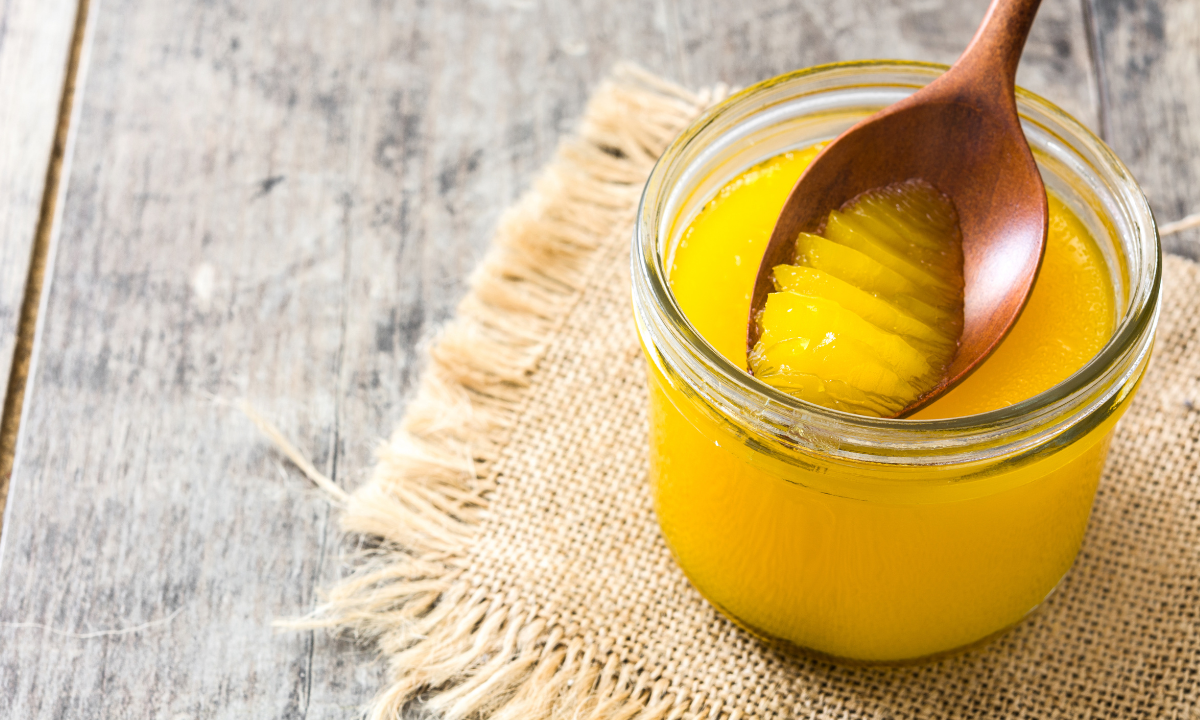
The clear golden color of pure clarified butter already suggests that Ghee is something very special. Ghee is also known as clarified butter or rendered butter fat. Compared to butter, it is lactose-free, more heat-resistant, has a longer shelf life, and is easier to store. This makes Ghee popular not only in Asia but also in European kitchens as a versatile cooking fat.
What few know: Especially in Ayurvedic medicine, Ghee is used in various ways as a high-quality and proven healing agent. Ghee is easily digestible, has anti-inflammatory effects, promotes wound healing, and is considered a strengthening, cleansing, and harmonizing universal remedy.
The Most Important Facts at a Glance
- Ghee is lactose-free and more heat-resistant than butter.
- In Ayurvedic medicine, Ghee is valued as a healing agent.
- Ghee can be used for detoxification and wound healing.
What is Ghee?
Ghee is butter from which protein and water have been removed through a slow cooking process and clarification. This makes Ghee lactose-free and very long-lasting even without refrigeration. For example, 100-year-old Ghee is attributed special healing properties in Ayurvedic medicine.
So Many Varieties of Ghee!
Ghee is now offered by many manufacturers. A good manufacturing process and the quality of the butter determine the taste and shelf life of the product. In India, there is also Ghee made from buffalo, camel, sheep, mare, and goat milk, but these are rarely used here.
Coconut Ghee
One variant of Ghee is Coconut Ghee. It consists of half butter Ghee and half coconut fat. It not only tastes delicious but can also be heated even higher.
Butter - the Basis of Ghee
In our latitudes, the starting basis for clarified butter fat is cow's milk and the butter derived from it. Approximately 25-30 liters of whole milk are needed to make one kilogram of butter.
Table: The Average Composition of Butter
| Fat and Lecithin | approx. 82% |
| Water | approx. 16% |
| Protein | approx. 1% |
| Milk Sugar | approx. 0.5% |
| Mineral Salts | approx. 0.5% |
| Vitamins | A and D |
Buttermilk
Buttermilk is created as a byproduct of sweet cream butter production, the milk liquid separated from the cream. This occurs through the addition of lactic acid bacteria.
In Indian, the milk liquid that separates from the cream is also known as Takra and is either used as a Pitta-reducing forehead massage or, if allowed to stand and thicken a bit longer, is eaten like yogurt with a spoon.
Which Butter to Use for Ghee?
Depending on taste preference, sour cream butter, sweet cream butter, or mildly cultured butter can be used for homemade rendered butter fat. Classically, sweet cream butter is used for Ghee production due to its creamy sweetness. Experience also shows that it has less precipitation than sour cream butter during the manufacturing process.
Ghee in Ayurvedic Medicine
In Ayurveda, Ghee is considered the best of all fatty substances; it is said to strengthen memory, intellect, and digestion. Its properties are especially cooling, metabolism-stimulating, and strengthening. Additionally, Ayurveda attributes detoxifying and cleansing effects to clarified butter fat. In the Sushruta Samhita, one of the ancient Vedic texts, Ghee is described as the ultimate anti-inflammatory food.
Ghee cleanses the "srotas," the transport channels of the body, and thereby reduces "ama," metabolic waste.
Ghee: Detoxification in the Pancha-Karma Treatment
For example, in the intensive Pancha-Karma cleansing treatment, large amounts of liquid Ghee are consumed to prepare for the detoxification procedure. The patient usually feels nauseous during this, which is why they are often advised not to lie down. The large amount of Ghee consumed over several days is meant to flush the elevated Dosha from the cells. All fat-soluble metabolic wastes and toxins can ultimately be eliminated through the gastrointestinal tract.
Ghee in the Ayurvedic Home Pharmacy
The cleansing and cooling properties of Ghee work wonders when applied externally for sunburn, burns, and closed skin inflammations.
Ghee in Ayurvedic Eye Treatment
During eye treatment, Aksi Tarpana, the eye is bathed with liquid, hand-warm Ghee. Typically, a ring made of chickpea flour is placed around the eye to prevent the Ghee from spilling out; an eye bath cup serves the same purpose. Especially for inflamed eyes, after long computer work, hay fever, or very dry eyes, regular treatment with Ghee is soothing and quickly provides relief.
A pleasant side effect of eye treatment with Ghee is the smoothing of fine, delicate skin around the eyes.
Ghee as Medical Cosmetics
Ghee can be used for external medical and cosmetic purposes and supports wound healing. If you have sensitive or reddened skin, use a cotton pad with some Ghee on it to remove makeup, or apply some Ghee to reddened areas of skin.
Medicated Ghee – Ayurvedic Gritham
To achieve particularly intensive and sustainable detoxification of body and brain, Ayurvedic medicine uses so-called medicated Ghee, which is made in an elaborate process. For this, the Ghee is mixed with various healing herbs and simmered for up to 100 hours. This method is said to intensify the effect of the healing herbs and the cleansing action of the Ghee on the body.
Prepared with appropriate Ayurvedic healing herbs, the so-called Gritham are created. The most well-known are Triphala Gritham, Panchatikta Gritham, Brahmi, or Ashwagandha Gritham. Depending on the prescription by an Ayurvedic physician, these are used internally or externally.
Making Ghee Yourself: How Easy It Is to Prepare Ghee
What You Need
- Organic butter from free-range or grass-fed cows (500g butter yields approx. 360-380g Ghee)
- 1 large stainless steel pot with a thick bottom
- 1 stirring spoon
- 1 fine skimmer spoon
- 1 large fine-mesh sieve
- 1 fine-pored thin cotton cloth / a square cloth diaper
- 1 large glass jar with screw cap
- Duration: Approx. 1 hour
Step by Step
- Slowly melt the butter on low heat in the pot. Stir evenly while doing so.
- During the separation process, white foam collects on the surface. This is the protein separating out. Skim it continuously with a skimmer spoon.
- Pour the clear liquid through the fine-mesh sieve, which has been previously lined with the cotton cloth, to catch the last protein residues.
- Pour the clarified butter fat into a jar, close it, and place it upside down. This creates a vacuum and keeps it fresher longer.
- Enjoy your homemade Ghee in the kitchen and home pharmacy.
Conclusion
Ghee is a valuable, versatile fat that has a firm place in both the kitchen and Ayurvedic medicine. It is lactose-free, long-lasting, and offers numerous health benefits. The production of Ghee is simple and can easily be done at home to benefit from the many advantages of this "gold of Ayurveda."