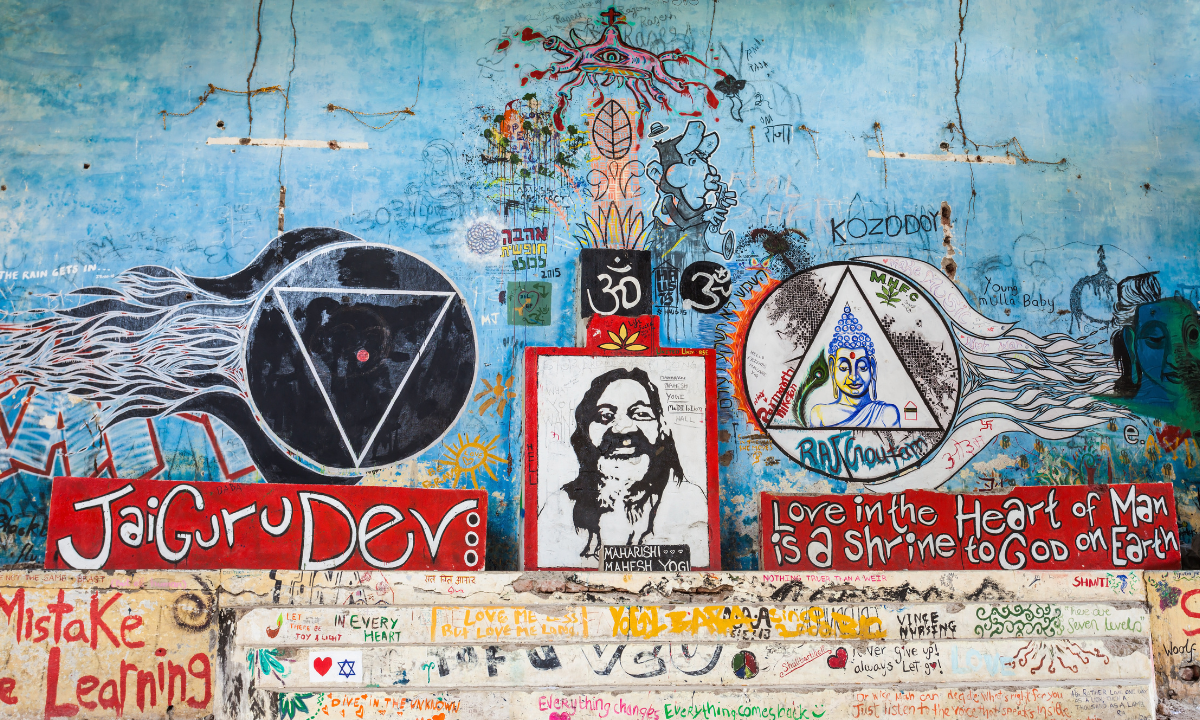
In early May, our boss Sabine was traveling through Northern India on her motorcycle and brought us a travel report. Come along on a journey through Rishikesh, the much-praised capital of yoga, and learn more about Maharishi, the yogi, his ashram, and the roots of Maharishi Ayurveda.
The Essentials at a Glance
- Rishikesh is known as the capital of yoga and home to the Maharishi Mahesh Yogi Ashram.
- The Maharishi Ashram, also called the "Beatles Ashram," attracts visitors with its mystical atmosphere.
- Maharishi Mahesh Yogi founded the Spiritual Regeneration Movement (SRM) and promoted Transcendental Meditation (TM).
- Maharishi Ayurveda emerged from the collaboration of Ayurveda experts, doctors, and scientists.
- Today, Maharishi Ayurveda is an international network of doctors, clinics, and schools.
The Journey to the Yoga Pilgrimage City of Rishikesh
Shortly after my arrival in Delhi, I set off on a journey to the legendary city of Rishikesh. An aura of mysticism precedes this pilgrimage city. This is likely due to the many temples and ashrams and the proximity to the source of the Ganges. In the West, Rishikesh is also known for being home to the Maharishi Mahesh Yogi Ashram. A Hindu meditation center that, especially in the 1960s, attracted countless Western celebrities for meditation retreats.
Rishikesh is located at the foot of the Garwahl Mountains at the foothills of the Himalayas and on the Alaknanda, a tributary of the Ganges. The city is surrounded by rocks and forest and borders a sacred river. My first small exploration tour takes me directly down to the water. Past countless small "India shops," where all those things considered typically Indian are sold: small and larger statues of various deities, incense sticks, colorful clothes and shirts, stones, little chains, and all manner of other trinkets.
Every evening at the water, pujas, fire ceremonies, sacred chants, and ceremonial ablutions take place, to which hundreds of pilgrims, believers, and tourists descend the steps to the river, and where small leaf boats with candles and incense are set adrift and offered to the river until nightfall.
The Maharishi Mahesh Yogi Ashram
Downstream behind a bridge, I discover a small path. At its end, I stop in front of a stone gate. The grounds of the former Maharishi Ashram, also called the "Beatles Ashram" because of the Beatles' stay there in 1968, stretches widely along a mountainside. The legendary "White Album" by the Beatles is said to have been created largely here. The ashram's heyday was in the 1960s and 1970s, and it is credited with opening Western interest to yogic and spiritual India.
Due to financial difficulties, the grounds were transferred from private to state custody some years ago and have since fallen into disrepair. Now the over one hundred small stone houses are entwined by nature and its green climbing plants, while the government tries to profit from the ruins. The grounds can be visited for a fairly high entrance fee of 600 rupees.
Following in the Beatles' Footsteps
I pay the guardian at the stone gate and begin my exploration. Between the stone huts arranged in small groups, some of which have crumbled into ruins, and within the huts themselves are stairs leading to the upper floors and onto a platform. I climb up and look out from one of the small terraces across the property. Even though the grounds have since fallen into disrepair and become overgrown, the place has a peculiar charm. It is quiet up there, the river is barely audible, and the sounds of the city have completely faded into the background. As if in another world, I stand on the meditation hut in the midst of greenery. I leave the stone hut and continue across the property, further into the increasingly dense jungle, where my thoughts are accompanied by the sounds of crickets and the primeval forest.
The Founder Maharishi Mahesh Yogi
Maharishi Mahesh Yogi was born as Mahesh Prasad Varma. In 1958, he founded the Spiritual Regeneration Movement (SRM), which aimed to bring happiness, world peace, and health. Maharishi became known especially through the techniques of Transcendental Meditation (TM) and the associated "yogic flying." According to his claims, the technique is based on ancient Vedic texts and the oral traditions of his teacher Brahmananda Saraswati.
Maharishi - Guru and Businessman
Maharishi's esoteric ideas did not find fertile ground in India, which is why in the late 1950s he set out through various Asian stops to America and Europe. Among other things, it was his lectures and seminars that brought him and his TM numerous followers in the mid-1960s and which put spiritual India in the focus of New Age followers.
To attract media attention, Maharishi invited famous personalities such as the Beatles, Mia Farrow, the Beach Boys, and other film and pop stars to meditation courses at his ashram in Rishikesh. Although the Beatles did not stay long, this invitation was a clever PR move that brought TM and especially Maharishi significant media interest.
On January 11, 2008, Maharishi announced his retirement. On February 5, 2008, according to a witness account, he "assumed the perfect yoga position" in which he "peacefully fell asleep." His body was then transferred from the Netherlands to Allahabad, India, and cremated. His ashes were scattered in several Indian rivers as well as distributed throughout numerous countries.
The Roots of Maharishi Ayurveda
In the 1970s, Maharishi inspired Ayurveda experts, doctors, and scientists from India and the Western world. The birth of "Maharishi Ayurveda" came when they joined together and worked to collect the ancient traditions of Ayurveda, complete them, and verify them using modern scientific methods. They called this holistic and Western-informed form of Ayurveda "Maharishi Ayurveda." Today, Maharishi Ayurveda forms an international network of doctors, clinics, and schools.
Conclusion
Rishikesh and the Maharishi Mahesh Yogi Ashram offer a fascinating blend of history, spirituality, and nature. The place continues to attract many people today who walk in the footsteps of the Beatles or wish to experience the roots of Maharishi Ayurveda. Maharishi not only popularized Transcendental Meditation but also made an important contribution to the revival and spread of Ayurveda.