What a subtle anise or mint sweet is in Central Europe after a meal, in India is the chewing spice blend Mukhwas. A spice mixture whose name already makes it clear why you chew it: Because Mukhwas translates to "mouth-odor". We know the chewing spice mixture from trips to India or from Indian restaurants. The Indian spice blend is served after meals or already on the table: Mukhwas is usually a colorfully dyed grain mixture coated with sugar.
But the whole thing works without sugar and artificial flavorings. That's why we mixed our own Mukhwas. Here we would like to share the basic recipe for our digestion-promoting and aromatic chewing spice mixture with you.
The Most Important at a Glance
- Mukhwas is a traditional Indian chewing spice blend.
- Pan Mukhwas contains betel leaves, which are replaced by peppermint in our mixture.
- Mukhwas has a balancing effect on all Doshas and promotes digestion.
Betel Leaves: How Mukhwas Becomes Pan Mukhwas
Mukhwas is the name for chewing spice consisting mainly of anise, fennel and coriander. The mixture is more commonly known by the term Tambul. The Sanskrit term "Tambula" refers to the chewing of betel leaves. The addition "Pan" in Pan Mukhwas also refers to the betel nut leaf, in which the mixture is traditionally wrapped.
Betel is known as an ingredient in betel quid, which consists of a variety of ingredients, betel leaf, betel nut, lime in the form of eggshell and much more. This mixture, rolled in a betel leaf, is chewed as a stimulant in Southeast Asia. You can easily recognize the users by their dark red stained teeth from the mixture. The red color results from the interplay of substances - none of the ingredients colors red alone, and thus neither does the betel leaf. The leaves contain eucalyptol, a breath-freshening essential oil. They have a stimulating and antiseptic effect. Our friendly neighbor from Sri Lanka recommends chewing the Mukhwas spice chew with fresh betel leaves.
However, since you need fresh betel leaves for this, betel is not included in our mixture. Perhaps you will get some – as we do – from your trusted Asian shop!
We recommend and use domestic peppermint as a "substitute". Our tip: In addition to the spices, feel free to add a fresh peppermint leaf to your mouth and chew it.
Bad Breath from an Ayurvedic Perspective
Bad breath not only results from eating onions and garlic, but also from insufficient Agni (digestive fire) and the resulting digestive problems. Food is not completely broken down and digested in the gastrointestinal tract, creating unpleasant bloating gases. Ama (metabolic waste) accumulates in the tissues, and a white to yellowish coating forms on the tongue. First, the Vata Dosha increases, then Pitta after some time.
How Does Mukhwas Work on the Doshas?
To stimulate Agni and create a balance of the Doshas, the spices in the Mukhwas mixture have a balancing effect on all Doshas. Why? They contain all taste profiles: sweet, salty, sour, astringent, sharp and bitter.
By thoroughly chewing the grains, their essential oils unfold in the mouth.
Intensify this naturally fresh aroma by drinking half a cup of warm water afterward. Since the spices are swallowed, they unfold their further effects in the gastrointestinal tract.
Basic Recipe for Pan Mukhwas
India would not be India if there were not a variety of recipes. We chose the traditional mixture without the addition of sugar-coated colorful spices and without additional aroma oils. Modify the basic mixture according to your own taste.
Mix the following spices in equal parts for your own Mukhwas:
| Anise | A carminative (plant remedy for bloating) with digestive-soothing effects. Especially for bloating and colic. The taste is aromatic and sweet. |
| Fennel | Also a carminative. Its cooling properties reduce Pitta, which is why Ayurvedic medicine recommends it for inflammations and fever. The oily, sweet quality reduces Vata. |
| Coriander | Balances all three Doshas. The seeds have carminative, detoxifying, anti-inflammatory, diuretic effects and help with bad breath. |
| Sesame | Chewing sesame is considered strengthening for teeth and gums in Ayurveda. Sesame contains valuable vitamin E. Since some people are allergic to sesame, it is appropriately labeled as an allergen in our mixture. |
| Himalayan Rock Salt | Salt has the Ayurvedic properties suksma (penetrating) and srstamala (eliminating waste malas) and pacifies Vata. |
| Peppermint Leaves | They give the mixture its fresh taste and the user fresh breath. |
Still Having Problems? Ayurvedic Recipe for Bloating
If your digestion is irregular and you suffer from severe bloating, we recommend the following paste based on a recipe by A. Zoller and H. Nordwig – Medicinal Plants of Ayurvedic Medicine:
Recipe for a homemade digestion-regulating, anti-bloating paste:
- 20 g coriander seeds
- 20 g Cumin / Cumin
- 10 g black pepper
- 10 g cloves
- 5 g rock salt
- Juice of ½ lemon
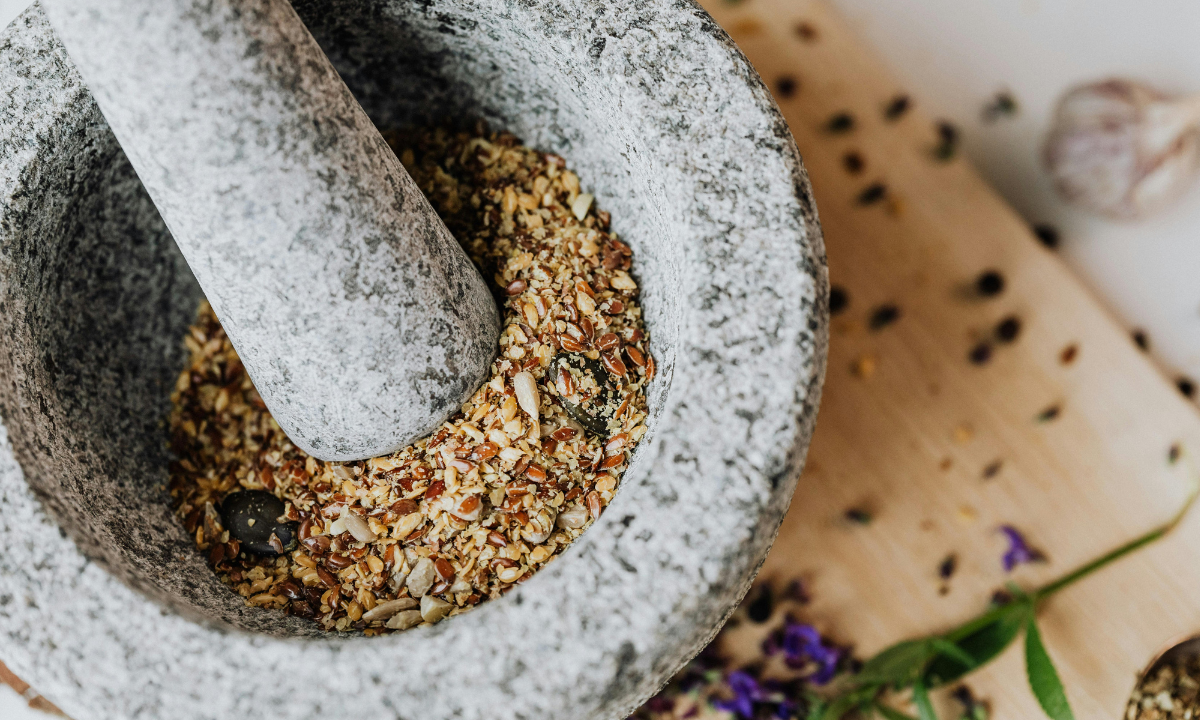
Roughly grind or mill the seeds, mix with lemon juice and salt, and stir into a paste. Spread this on fine paper and let it dry in the shade in the air. Grind the dry paste again and store in a jar.
After meals, chew ½ to 1 tsp of the mixture and drink a glass of warm water afterward.