Most people know pepper as black, white, red or green peppercorns. What few know: green, black, white and red pepper are simply different ripening stages of the berries from one and the same plant – the piper nigrum! However, beyond that there are countless little grains with the name pepper, which deserve to be described and, above all, tried!
The essentials at a glance
Where pepper grows – the origin of peppercorns
Everyone knows the saying "go where the pepper grows!" People used to wish someone far away in anger, because pepper doesn't grow in our latitudes, but in distant lands.
Although pepper grows so far away, it has been consumed in Europe since ancient times. The Romans established a trade route mostly overland to India. For a long time, pepper was a true luxury commodity and could be weighed against gold. The direct sea route to India was not established until the end of the Middle Ages. Vasco da Gama, a Portuguese seafarer, traveled this route as the first European and reached Calicut, today's Kozhikode, on May 20, 1498. Calicut lies in the south Indian state of Kerala on the Malabar coast. Not without reason is this also called the Pepper Coast. Pepper only became an everyday spice through the great European trading companies in the 17th century, who brought pepper to Europe in large quantities for the first time.
The pepper bush – how pepper grows
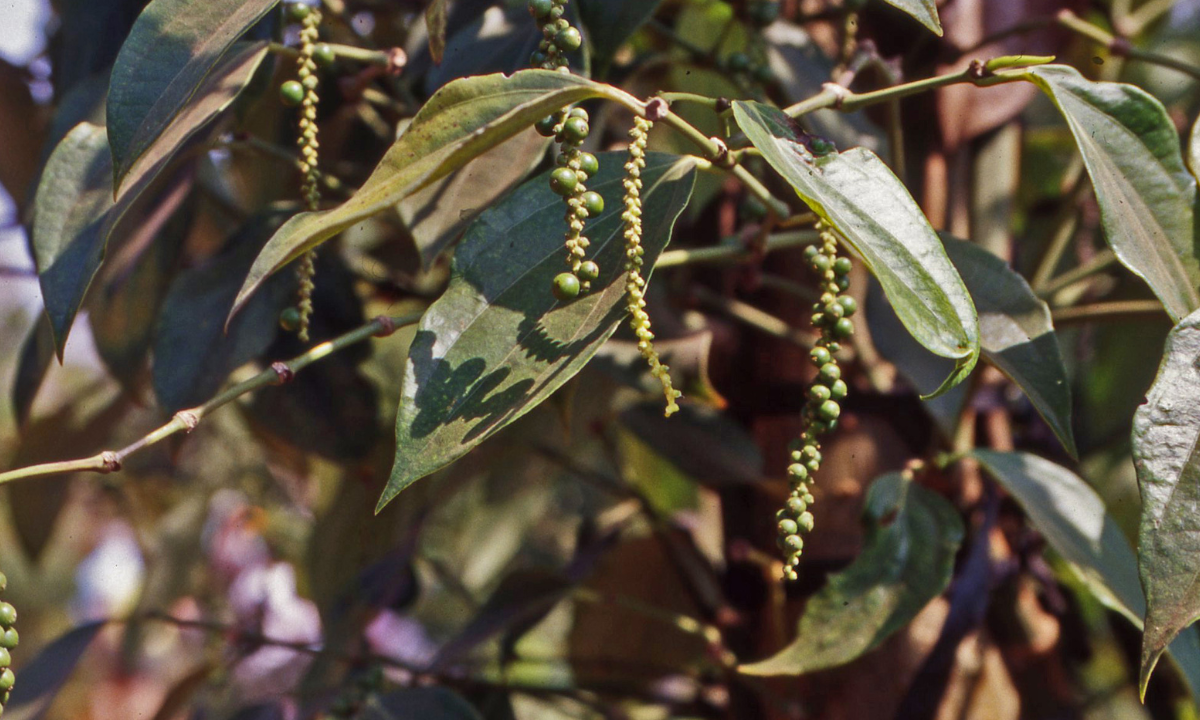
Actually, the pepper bush is a climbing plant that grows similarly to our ivy or a twining plant. In the forests of South India, the pepper bush often grows wild and winds up around evergreen tropical trees. The peppercorns grow on long, downward-hanging spikes that can be harvested twice a year.
Many colorful peppercorns – the ripening stages of true pepper
Green pepper is still unripe and is harvested very early and often preserved fresh in salt water or freeze-dried. Black pepper is also obtained from the unripe green to yellow-orange peppercorns and dried. It only becomes wrinkled and black through drying. White pepper is only obtained from the ripe peppercorns. After harvesting, it is stripped of its shell, soaked and bleached in the sun. Red pepper is also a completely ripe peppercorn. It retains its delicate shell around the grain and is rather rarely found in commerce. All green, black, white and red pepper are berries from one and the same plant: piper nigrum.
The other pepper varieties – Pippali, piment, etc.
Besides the varieties of "true pepper", there are many other types in the colorful world of pepper. Long pepper, also called Pippali, comes from the pepper species piper longum, which is related to "true pepper". It is used less frequently in the kitchen, but is contained in the turmeric-pepper mixture because it increases the bioavailability of coumarin. Pippali is the treatment of choice for the Ayurvedic Vardhamana Pippali cure for eliminating metabolic waste "ama".
Cubeb pepper, also called tail pepper, is native to Southeast Asia and has a fruity, sweet-spicy taste. Sichuan pepper, also called Chinese pepper, comes from the Rutaceae family and is recommended in Chinese medicine as an antioxidant.
Timut pepper from Nepal is a relative of Sichuan pepper and has a wonderful citrus fruit aroma. Paradise grains from West Africa, also Guinea pepper called, are a staple in West African cuisine. Piment, also called clove pepper, comes from the Caribbean and is used in Christmas baking and curry mixtures.
Monk's pepper, also called chaste lamb, is used in naturopathic medicine to relieve various female ailments. Cayenne pepper is actually a chili variety and very hot. It should be dosed carefully as it increases Pitta.
Conclusion
Pepper is much more than just a hot spice on a breakfast egg. The variety of pepper types offers a wide palette of flavors and applications that are appreciated both in the kitchen and in Ayurvedic medicine. From familiar black pepper to exotic Timut pepper, there is much to discover and try.