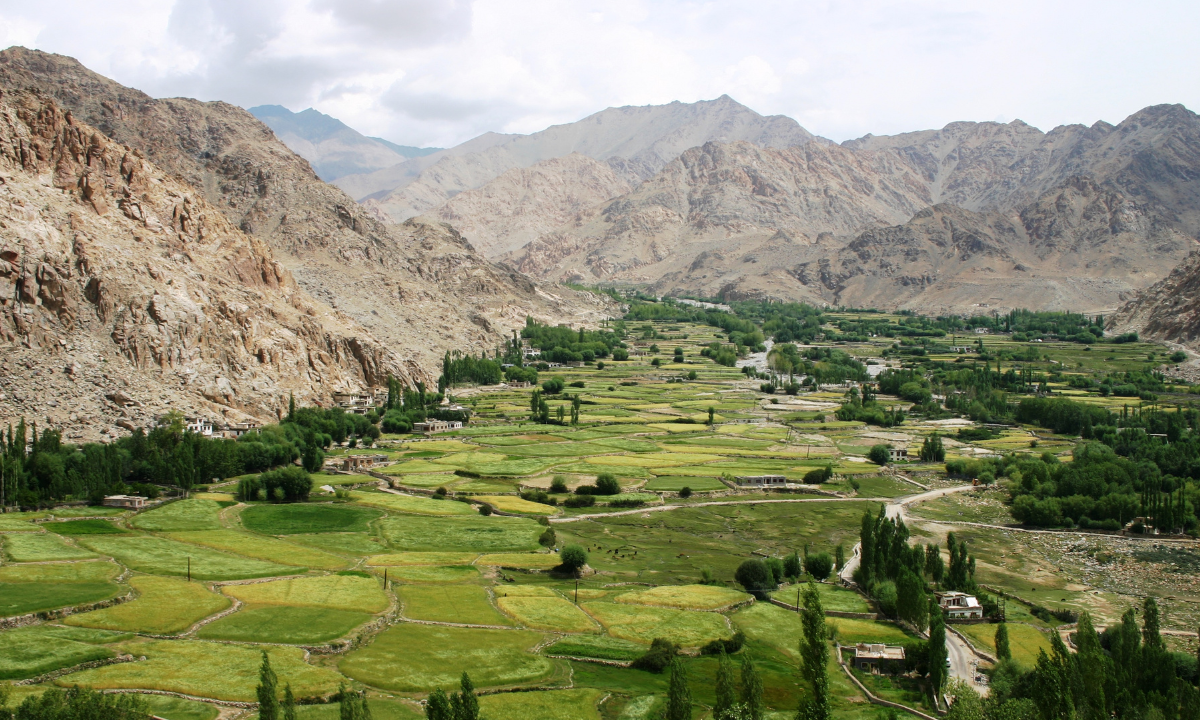
In the barren high valleys of the Himalayas in Ladakh, where the mountains are close to heaven, barley is the only grain that grows. The soil is mineral-rich, full of sand and stones, water is scarce, and the sun shines brightly. In the short warm months from June to September, the grain is usually harvest-ready by early to mid-August. The stalks are harvested by women with a sickle and the sheaves are laid out to dry.
The most important facts at a glance
- Barley is the only grain that grows in the high valleys of the Himalayas.
- Tsampa is created by roasting and grinding barley kernels.
- Barley has Vata-reducing properties in Ayurveda.
- Barley Tsampa can be prepared as a nourishing breakfast porridge.
Barley Tsampa: Tibetan staple food
The kernels are roasted and ground; this creates Tsampa or Satu, as it is called in Tibetan. The nutty barley flour serves daily nutrition. Some eat it plain with a sip of water. Mixed with butter or salty butter tea, small balls are formed and eaten.
What Ayurvedic properties does barley have?
Barley has a sweet taste with cool, heavy properties. The barley beer made from it, Chang, is sweet, sour, and bitter with sharp, warm properties. Barley contains plenty of protein and valuable minerals such as iron, magnesium, potassium, calcium, zinc, and copper. Additionally, it contains vitamins B1, B2, and E.
How is barley Tsampa used in Ayurveda?
In Traditional Tibetan Medicine (TTM) and Ayurveda, barley is given as a Vata-reducing, regenerating, and aphrodisiac Rasayana. According to Ayurvedic writings, its applications are diseases of the urogenital tract, spermatorrhea, hypertension, high cholesterol levels, colds, phlegm, shortness of breath, and diphtheria. Its ingredients calm the stomach and digestive system.
Important: If you suffer from any of these symptoms, consult with a healthcare practitioner and avoid self-diagnosis and self-treatment!
Barley Tsampa: Recipe for a delicious breakfast
You don't have to view Tsampa from an Ayurvedic medicine perspective to enjoy eating it: We love Tsampa as a fine breakfast porridge. Refined with a bit of Cinnamon and Cardamom, a spoonful of fruit braised in ghee, and drizzled with warm water or warm milk, oat or almond drink.
Conclusion
Barley Tsampa is more than just a staple food of the Himalayan region. It offers diverse applications in nutrition and Ayurveda. Whether as nourishing porridge for breakfast or as part of traditional medicine – Tsampa is truly a versatile gift from heaven.