What ginseng is to Traditional Chinese Medicine, Ashwagandha is to Ayurveda. Few ayurvedic medicinal plants are as popular as the winter cherry, also known as "Indian ginseng". Especially in Europe, this plant is valued as a so-called adaptogen. Ashwagandha
The Vata-reducing tonic has a positive influence on stress, concentration, tissue, fertility, and sleep, among other things. In this article, you'll learn how Ashwagandha is classified in Ayurveda, what effects are traditionally attributed to it, and in what forms it is used.
The Essentials at a Glance
- In Ayurveda, Ashwagandha is regarded as a strengthening and Vata-reducing Rasayana.
- The plant is used primarily for stress, exhaustion, sleep disorders, and nervous overload.
- Traditionally, the root and root bark are used most commonly.
- There are various forms of application, from Churna to capsules to tonics and oils.
- In Ayurveda, the focus is not only on the plant's effects, but always also on the cause of the imbalance.
Ashwagandha: From Winter Cherries, Horses, and Sleep Berries
A Brief Botanical Introduction to Withania somnifera
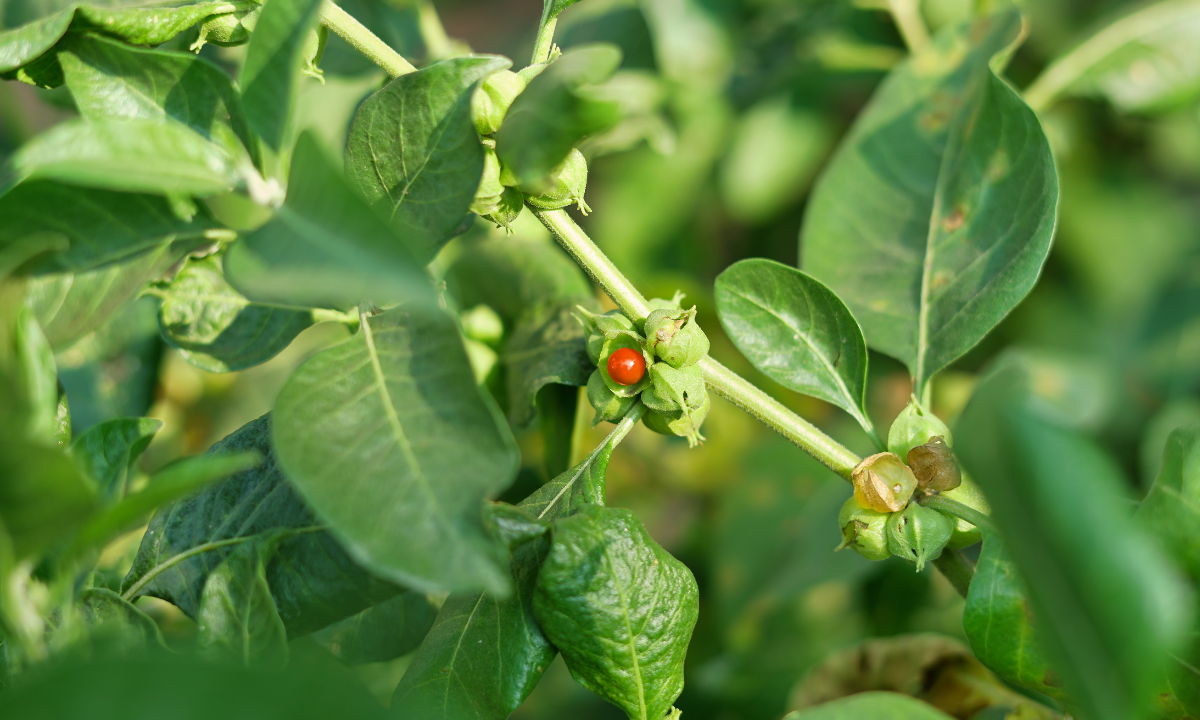
The small bushy plant with its inedible hard red berries is native not only to India, but also to the Mediterranean region and Africa. This partly explains why it is known in different linguistic regions and natural healing traditions.
Botanically, it bears the name Withania somnifera. In our region, it is also known as winter cherry or sleep berry and belongs to the nightshade family. Traditionally, in Ayurveda, the root and root bark are used most, as the active ingredients are particularly concentrated there.
What the Name Ashwagandha Reveals
The various names already tell us something about the plant. The term "sleep berry" hints at its connection to rest and sleep. In the Sanskrit name Ashwagandha, the focus is more on taste and effect: From ashwa for "horse" and gandha for "smell" or "taste" comes the name of the "horse-scented".
Anyone who remembers their first teaspoon of Ashwagandha Churna with hot water or warm milk will quickly find themselves, taste-wise, in a horse stable: sharp, slightly sweet, and bitter.
Overview: Ashwagandha and Its Applications
Ashwagandha is traditionally regarded as a strengthening agent for nerves, tissue, and resilience. You will also find the plant in the well-known Rasayana Chyawanprash. Typical for natural adaptogens is the combination of calming and strengthening effects without excessive stimulation.
The name "strength of the horse" also refers to vitality, building up, and fertility. Accordingly, Ashwagandha is traditionally also used in connection with fertility wishes and general weakness.
Important: Traditionally, the root and root bark are used primarily, not the berries.
Ashwagandha and Its Adaptogenic Properties
An adaptogen is a plant that can help the organism adapt to the effects of physical and emotional stress. Simply put: Adaptogenic plant substances are meant to reduce the imbalance created by constant stress.
The body actually has very good regulatory mechanisms that maintain balance in circulation, hormones, temperature, and other processes. However, during stressful phases of life, this balance is more easily disrupted. This is exactly where Ashwagandha traditionally comes into play.
Ashwagandha and Vata Disorders in Ayurvedic Medicine
In Ayurveda, prolonged overload is often associated with an increase in Vata. Vata is the principle of movement and influences the nervous system, circulation, metabolism, and mental activity, among other things. When Vata becomes unbalanced, sleep, concentration, and inner peace are often affected.
Typical Vata complaints include restlessness, anxiety, insomnia, nerve pain, dizziness, or general sensitivity. Ashwagandha is therefore often used in Ayurveda where stabilization, grounding, and regeneration are needed.
From an Ayurvedic perspective: Ashwagandha is particularly interesting when stress, restlessness, exhaustion, and nervous overload are in the foreground.
Ashwagandha Effects and Applications
This is exactly where Ashwagandha shines as an adaptogen. Traditionally, the plant is used to support the body's resilience to stress, promote regeneration, and counteract Vata-related complaints.
Ashwagandha is particularly often used in Ayurveda for Vata-related complaints, such as restlessness, sleep disorders, cramps, nervous tension, pain, exhaustion, and in the urogenital tract. During menopause, the plant is also traditionally used to alleviate accompanying symptoms such as insomnia and inner imbalance.
In short: In Ayurveda, Ashwagandha primarily works on the thyroid, central nervous system, and urogenital tract.
For Ayurveda Specialists: Rasa and Guna
Ayurvedic medicine also describes the effects of medicinal plants through taste and properties. Due to its sharp, slightly sweet taste, its oiliness, and its heating effect, the Ashwagandha root is considered Vata- and Kapha-reducing.
Ashwagandha During Pregnancy and Other Contraindications
Oral use of Ashwagandha is not recommended during pregnancy. Also, in cases of thyroid disease or when taking thyroid hormones, Ashwagandha should only be used in consultation with medical supervision.
Important: In cases of thyroid disease or corresponding medication, Ashwagandha should only be used with medical supervision and monitoring.
Forms of Administration: Ashwagandha Powder, Capsules, Tea, and More
Since Ashwagandha is used very versatilely in Ayurveda, there are different forms of application. Traditionally, root and root bark play a major role. Depending on the goal, lifestyle, and tolerance, a different form may be appropriate.
Ashwagandha Churna
Classically, the Churna, i.e., the powder of the root, is taken with warm milk. Traditionally, it is regarded as a strengthening agent and is often used in small amounts several times daily. Those who cannot tolerate milk or live vegan can switch to plant-based alternatives.
Ashwagandha Capsules or Tablets
Capsules and tablets are the more practical variant of the powder. Usually, they contain filled or pressed Ashwagandha Churna. Depending on the manufacturer, there are products with pure root powder or more concentrated extracts. It's worth checking the dosage information.
Ashwagandha Liquid in Asavas and Arishtas
Asava and Arishta are traditional Ayurvedic herbal beverages. Through special preparation, plant ingredients are well-extracted. Some people particularly appreciate this form because it fits well into daily life and is pleasant to take.
Ashwagandha Gritham
Preparation with ghee makes Ashwagandha a classic tissue-building agent. In Ayurveda, this form is used primarily for neurological complaints, sleep disorders, and to strengthen mental faculties.
Ashwagandha as Avaleha
Rasayana pastes based on Ashwagandha, honey, ghee, and spices are traditionally used as a strengthening morning paste. They are considered building and are often well-accepted by children.
Ashwagandha in Tea
Ashwagandha is also found in selected tea blends or can be incorporated into your own recipes. This form is particularly suitable for those who prefer to integrate herbs gently and ritually into their daily lives.
External Use: Ashwagandha Oils
As a component of Taila and other Ayurvedic oils, Ashwagandha is applied externally primarily for tension, pain, and Vata complaints. The warming and relaxing effects are particularly beneficial.
Ashwagandha as a Living Plant
Those who wish to cultivate Ashwagandha themselves can certainly try. However, in our climate zones, the winter cherry is not winter-hardy and needs a protected location during the cold season.
From Practice: the Strengthening Effects of Ashwagandha
For all Vata-related disorders, Ashwagandha is a good choice from the Ayurvedic perspective. The plant brings relaxation without strong sedation and can help improve sleep, inner peace, and resilience. As always, however, targeted use in cases of illness should be accompanied by therapeutic guidance.
Ashwagandha for Men
In practice, Ashwagandha is frequently used for unfulfilled fertility wishes. On one hand, because of its relaxing effect, and on the other, because of its traditional connection to vitality and building up. In Ayurveda in particular, it is primarily associated with men, while for women Shatavari is often recommended additionally.
Ashwagandha Powder Can Build Up During Chemotherapy
Ashwagandha is also traditionally sometimes used as an adjunct in the context of cancer therapies, for example for exhaustion and general weakness. In practice, it is sometimes combined with other strengthening herbs.
Ashwagandha for Animals
Ashwagandha is actually used in some natural healing contexts also for animals, for example in cases of nervous behavior, cramps, muscle problems, or pain. Here too, the Vata-reducing, relaxing, and strengthening effects are in the foreground.
Important: Especially in cases of fertility wishes, chemotherapy, or existing illnesses, Ashwagandha should not be used on its own, but with professional guidance.
In Ayurveda: Avoiding Causes Rather Than Treating Symptoms
Even though Ashwagandha is a potent adaptogen, Ayurveda always reminds us not only to treat symptoms but to recognize the causes of imbalance. So instead of just taking something and otherwise leaving everything unchanged, it's worth looking at your own lifestyle.
What drains your energy? Where does constant tension arise? Which routines nourish you, and which exhaust you rather? This is often where real change begins in Ayurveda.
Thinking Ayurvedically: The strongest healing doesn't come from a remedy alone, but from the combination of proper support and real change in daily life.
Conclusion
Ashwagandha is one of the most well-known and versatile medicinal plants in Ayurveda. Traditionally, it is used primarily for stress, Vata disorders, exhaustion, sleep problems, and weakness. The spectrum ranges from powder and capsules to tonics, pastes, and oils.
In short: In Ayurveda, Ashwagandha is primarily a strengthening, calming, and stabilizing Rasayana. It works most effectively when its use matches your condition and is embedded in an overall mindful lifestyle.